Time spent searching
Staff check resident rooms, laundry areas, storage spaces, carts, neighbouring rooms, and informal “found” locations—often without a shared record of what has already been done.
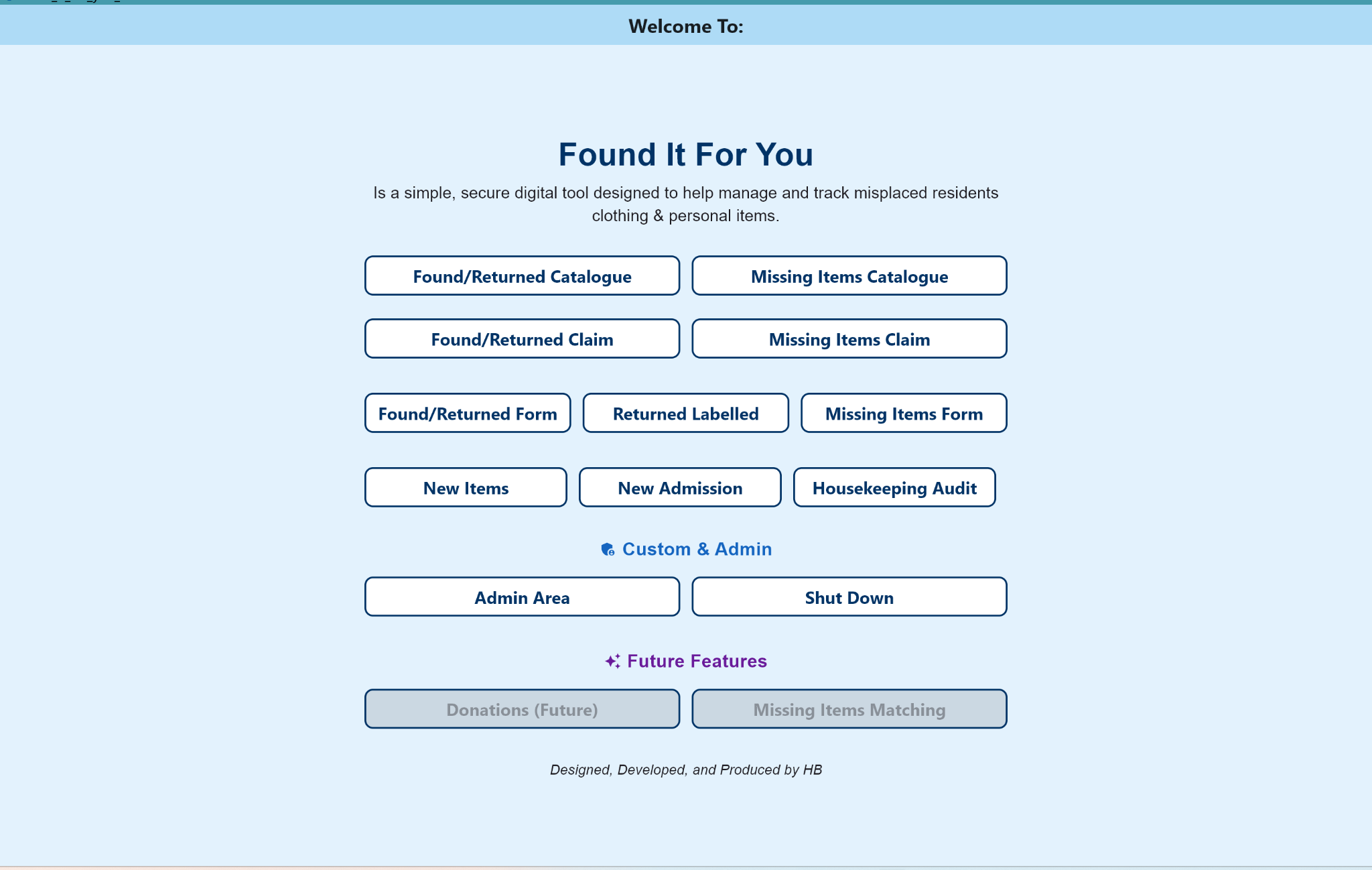
Found It For You™ helps long-term care homes document, track, recover, and report resident clothing and personal belongings through one clear, repeatable workflow—across departments, shifts, and staffing changes.
Missing clothing and personal belongings create repeated searching, family frustration, staff interruptions, inconsistent documentation, and uncertainty about what happened next.
Staff check resident rooms, laundry areas, storage spaces, carts, neighbouring rooms, and informal “found” locations—often without a shared record of what has already been done.
Paper notes, binders, whiteboards, verbal messages, spreadsheets, and staff memory can create multiple versions of the same process.
When a belonging cannot be located, families want to know when it was reported, what was searched, who was informed, and what follow-up occurred.
Turnover, vacations, agency staff, new hires, and changing responsibilities make informal processes harder to teach, follow, and control.
Without one structured system, the history of a missing, found, returned, or claimed item may be incomplete or difficult to retrieve.
Management may see individual complaints but lack a consistent record for identifying patterns, recurring locations, or opportunities for process improvement.
Consider how your current process works on a busy day, during a staffing change, or when the experienced employee who “knows where everything is” is away.
Found It For You™ creates a repeatable workflow so the next step does not depend on who happens to be working.
Discuss Your Current ProcessFound It For You™ brings related resident-property tasks into one organized system. Staff receive clear prompts, management receives consistent records, and the home gains a process that is easier to teach and maintain.
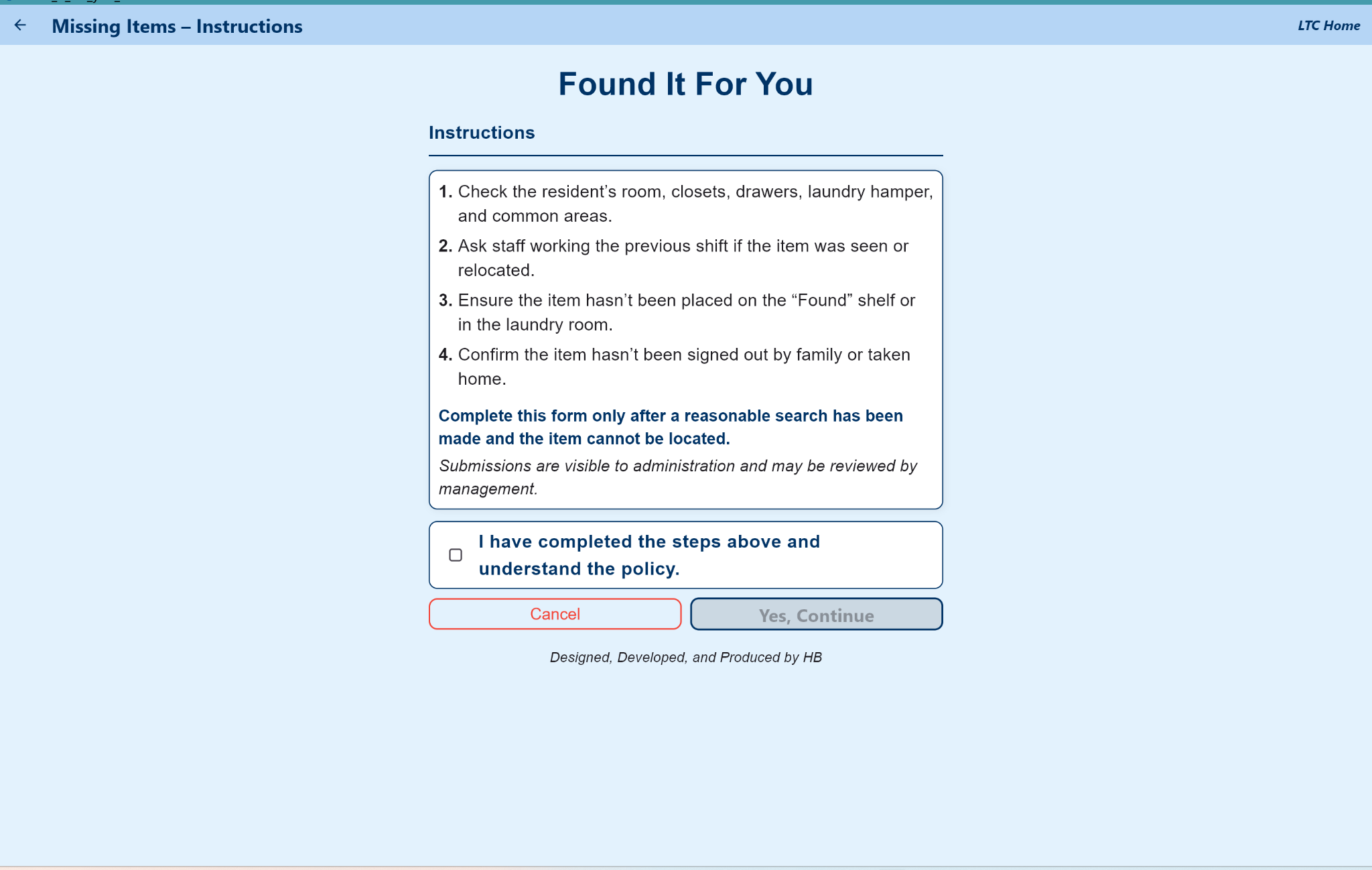
Before a missing-item report is created, staff can be guided through a reasonable search: room, drawers, closets, laundry hamper, common areas, found-item areas, previous-shift follow-up, and family sign-out checks.

Photos, item categories, size, colour, location, resident information, and staff details create a more useful record than an informal note such as “blue pants missing.”

When a staff member recognizes an item, the claim workflow records the resident and routes the item for labelling or return instead of relying on a verbal message that may be lost between shifts.

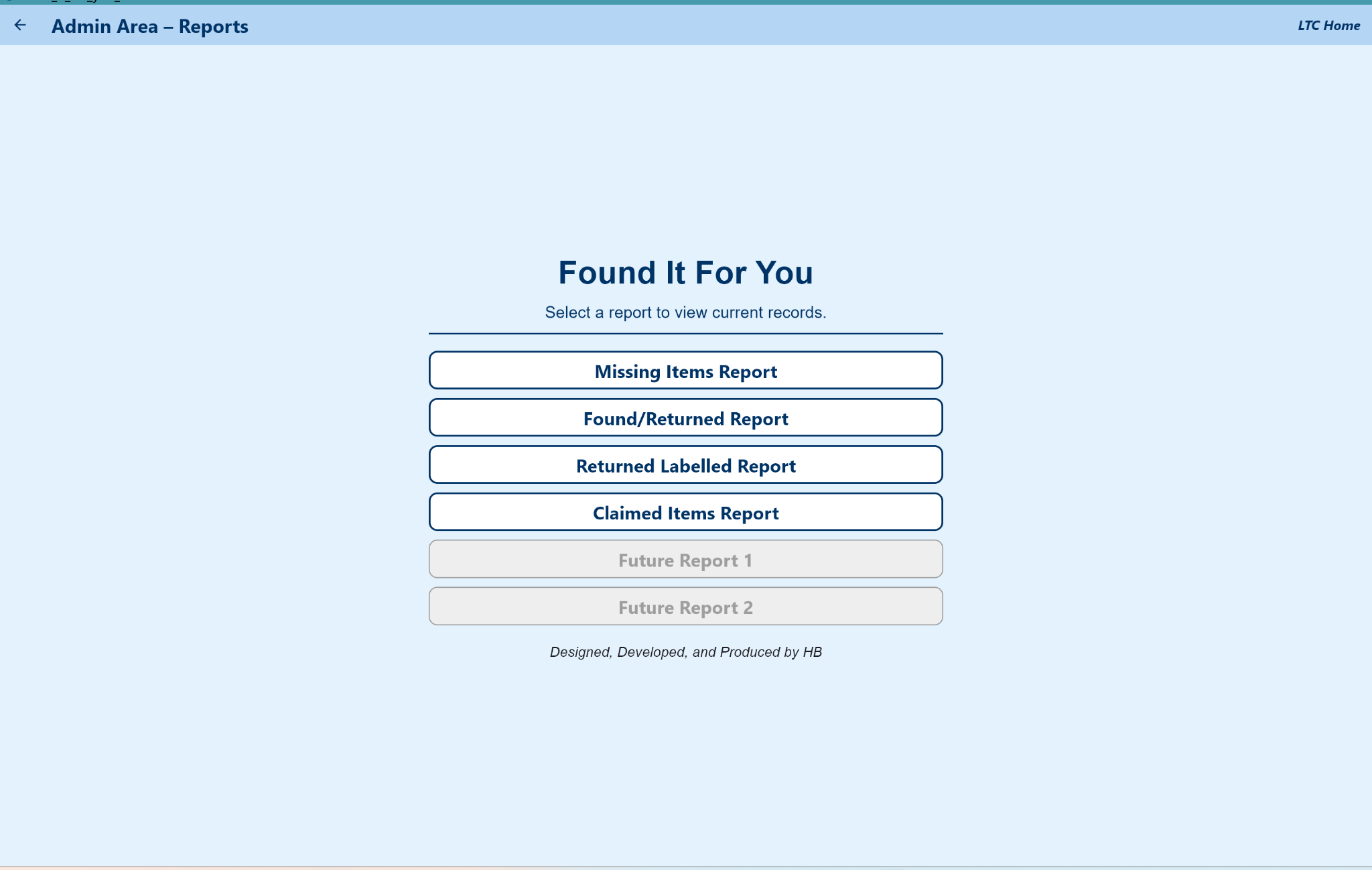
Standardized records support review of missing, found, returned, labelled, claimed, and resolved items. This helps managers follow up on individual concerns and identify recurring workflow issues.

“A process should remain dependable even when the people, shifts, and circumstances change.”
Experienced employees often carry unwritten knowledge about where items are placed, who should be contacted, and what happens next. A standardized digital process makes that knowledge easier to teach, follow, and maintain when staff change.
A more consistent record of what was reported, what steps were taken, and whether an item was returned or resolved.
Clear forms, prompts, catalogues, and next steps reduce dependence on memory and informal messages.
Review current records, monitor follow-up, and identify recurring issues using one standardized source.
A visible workflow helps staff understand the expected process without first learning several local workarounds.
Found, returned, new, unlabelled, and claimed belongings can be routed through defined workflows.
Consistent data makes it easier to discuss where the process breaks down and where improvement efforts should begin.
The system is designed around large, clear forms and straightforward actions for real long-term care environments.
Structured missing-item report
New-item intake
Connected workflowsA strong property-management process begins before move-in. Homes can use this guidance in admission packages and family conversations, then adjust it to their own policies.
This general guidance does not replace a home’s admission, laundry, safety, infection-prevention, or resident-property policies.
A home does not need to wait for new software to begin documenting resident belongings more consistently.
Start recording missing, found, returned, and new-resident belongings with a structured workbook designed as a practical first step.
Download the Free WorkbookA printable checklist covering labelling, quantities, laundry suitability, photographs, valuables, and record updates.
Download the ChecklistThe workbook helps a home begin. Found It For You™ provides the standardized workflow, catalogues, photographs, claims, follow-up, and reporting needed as the process grows.
Request a DemonstrationA demonstration and pilot conversation can focus on your current process, the departments involved, and how a standardized resident-property workflow would fit your home.
Not from a generic software template—from firsthand observation of an everyday long-term care problem and the people trying to manage it.
Found It For You™ was created by Heather Baird, Creator, Developer & Process Improvement Specialist, after years of seeing resident clothing and personal belongings become separated from their owners, staff spend time searching, and families seek answers from a process that was often informal or spread across departments.
Heather recognized that missing resident belongings were not simply isolated incidents—they were a process problem. Inconsistent documentation, changing staff, informal hand-offs, and separate departmental practices all made the same concern harder to manage than it needed to be.
The goal was simple: create a clear system that staff could actually use in a busy home. The result connects admission records, new items, found and returned items, missing-item reporting, claims, resolution, and management reporting while keeping the workflow practical.
The philosophy remains KISS: keep the process simple enough to follow, structured enough to manage, and useful enough to make a real difference.
No. Resident belongings can involve admissions, nursing, personal support, environmental services, laundry, reception, recreation, management, residents, and families. The system is designed to create a shared process across those touchpoints.
Prompts, defined forms, catalogues, and standard next steps make the process more visible and repeatable. This reduces dependence on one experienced employee’s memory and supports orientation for new, agency, and temporary staff.
No. The website shows selected screens and the business value of the workflow. Detailed configuration, administrative controls, reports, and complete processes are reviewed during a demonstration.
Yes. The application uses clear forms, large controls, photographs, and straightforward navigation suitable for touch-based use in the home.
The current product is designed for local deployment within the facility. Exact deployment, backup, access, and privacy arrangements are reviewed with each home before implementation.
Yes. The workbook is a useful starting point for homes developing a more consistent process. As records and hand-offs grow, the application adds connected photographs, workflows, catalogues, claims, and reporting.
I would be happy to discuss your current resident-belongings process, answer questions about the software, or arrange a demonstration.
Creator, Developer & Process Improvement Specialist
Found It For You™
Phone: 416-619-5983
Email: info@founditforyou.ca
Let’s review your current process and show how one standardized workflow can improve consistency, accountability, and communication.